
The Proof.
First the proof. Then the product.
Proof ladder: all four test stages passed
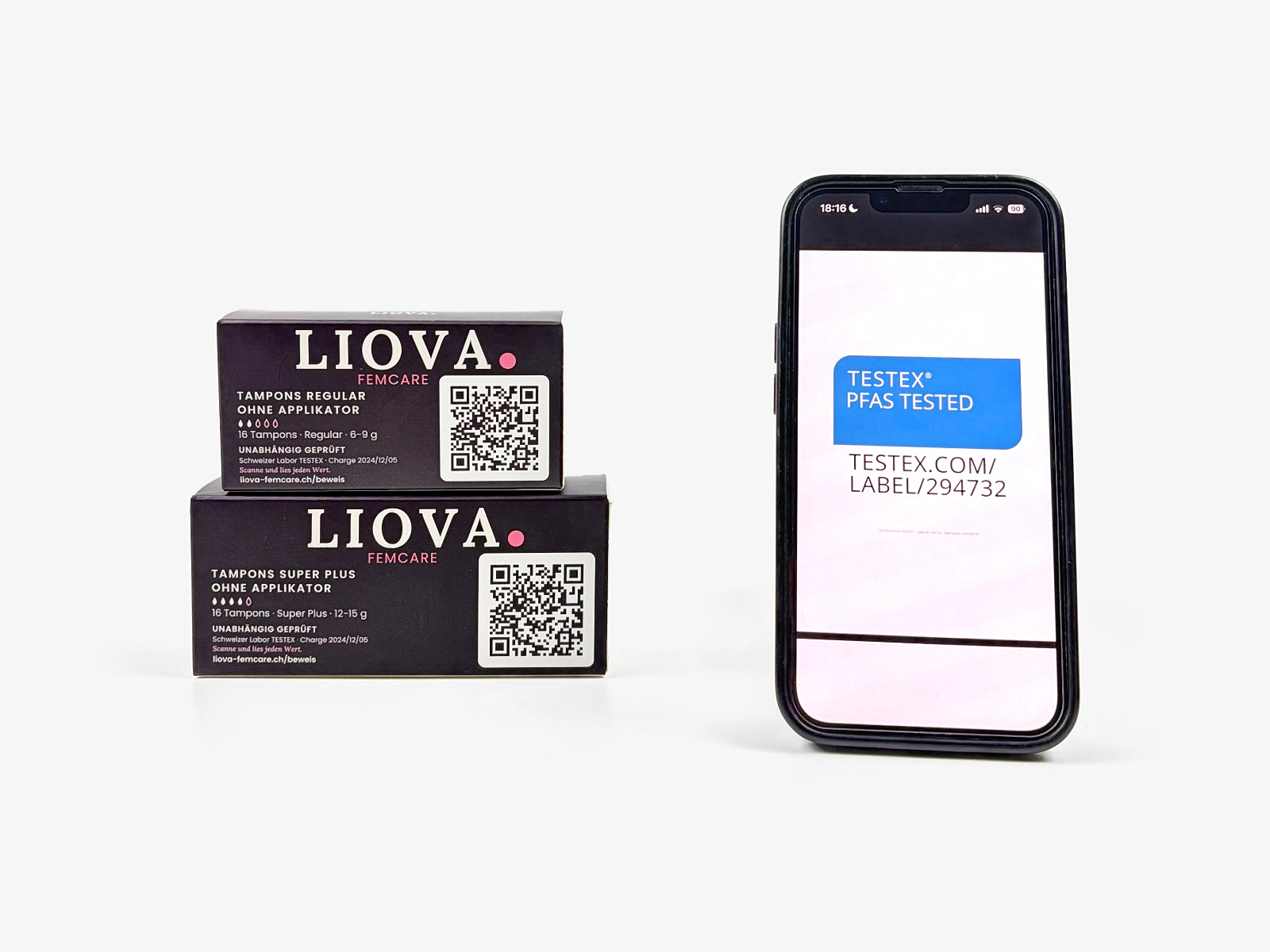
All legal limit values met; in the tampon core, no PFAS compound above the reporting limit.
 Label no. 294732, valid until 09.11.2027.
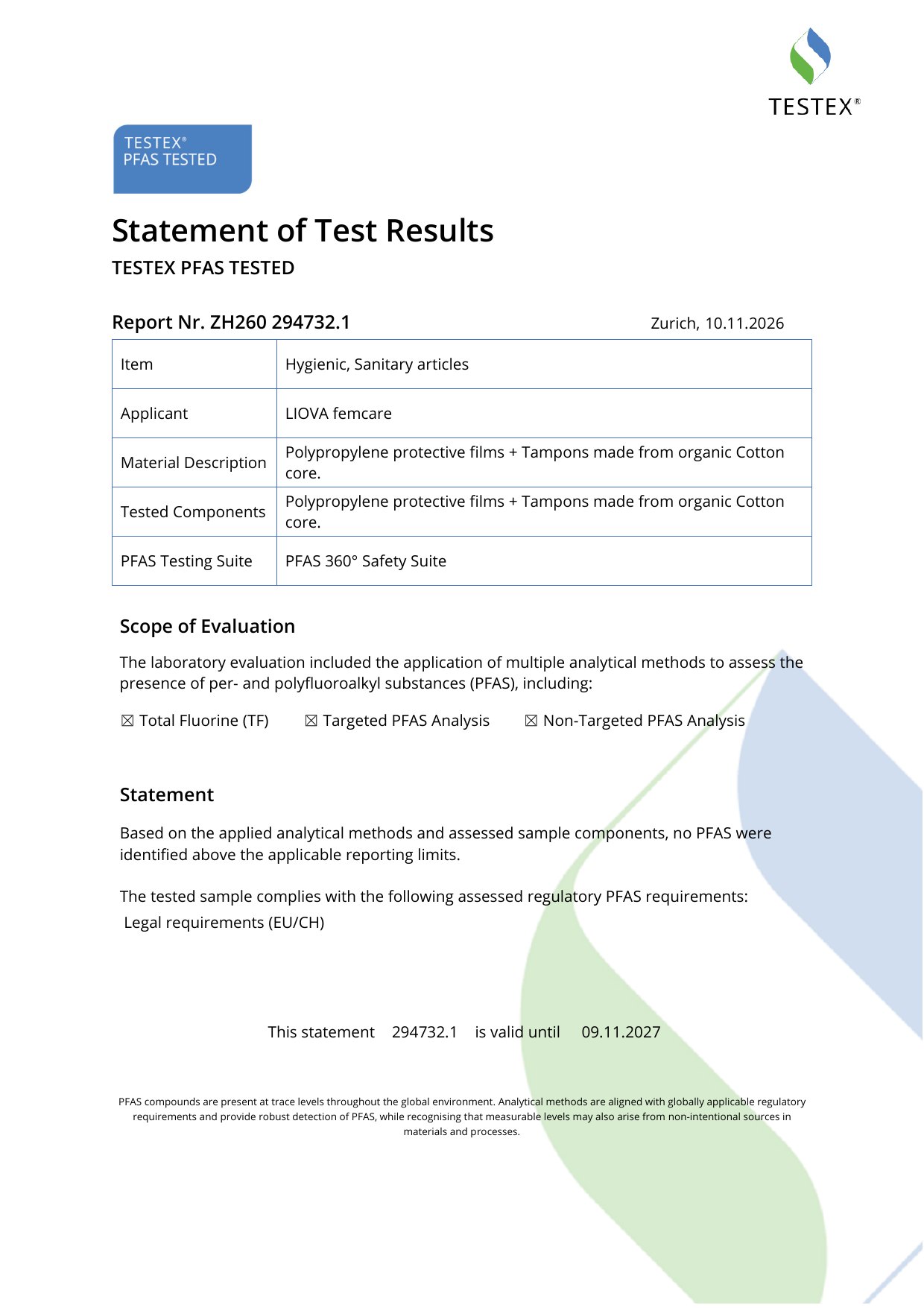
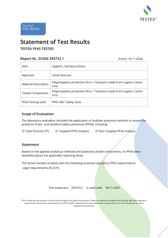
Statement of Test Results by TESTEX, Zurich, 10.11.2026. Original document. Tap to open the PDF.
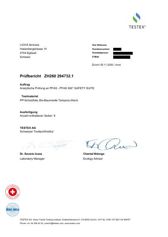
Three levels were tested: total value (total fluorine), targeted analysis, non-targeted screening. Report ZH260 294732.1 in full, private details redacted.
Independently tested at a Swiss laboratory (TESTEX, Zurich), batch-specific. Every single lab value is publicly available, no matter the result. Each stage is a separate test on our batch 2024/12/05; the ladder is only extended once a further test has been commissioned.
Every test stage has been passed. Sales have started.
A batch that breaches a limit value is not sold. Full stop.
Tap to open the complete table of values and the report as PDF. Nothing is summarised, nothing left out.
No laboratory can measure ‹zero›. It can only say: below the detection limit. That is why every measured value on this page sits next to its limit value.
Measured value: The amount of a substance the laboratory measured in our sample, in mg/kg (milligrams per kilogram).
Limit value: The maximum amount the test standard allows for this substance. If the measured value is below it, this substance has passed.
Detection limit: The smallest amount a measuring method can still reliably detect. Below it, no laboratory can tell «a little» from «nothing».
The sign «<»: The substance was below the detection limit. The number after it is the detection limit, not the measured value.
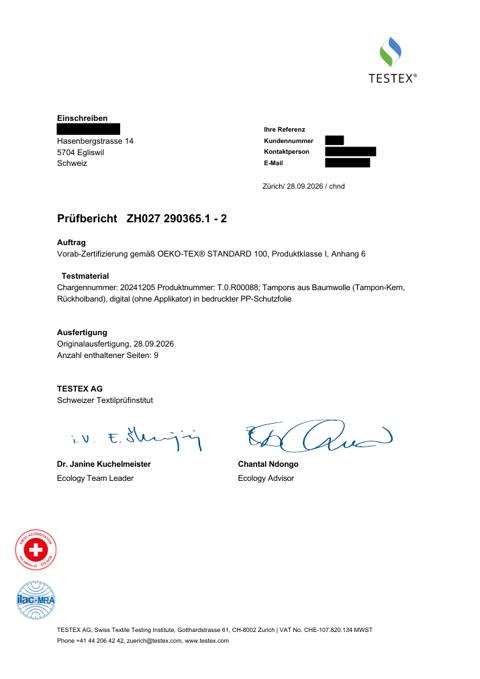
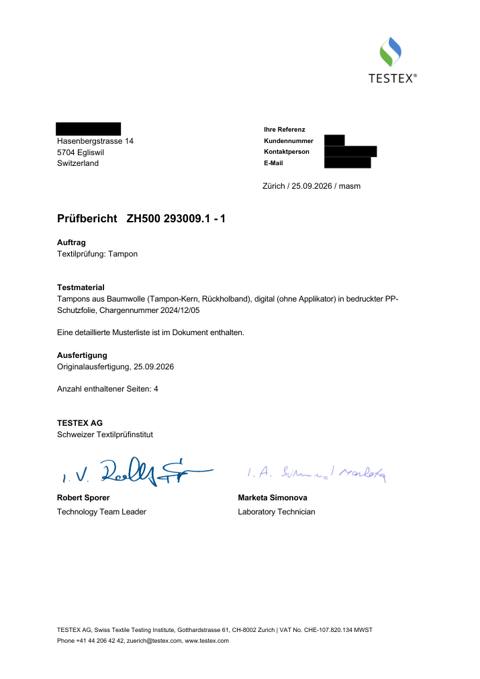
Independently tested at the Swiss laboratory TESTEX Zurich for six parameters in ten individual tests. Submitted: the tampon (cotton core and withdrawal string) and the wrapper (polypropylene). Test report ZH027.290365.1, final version dated 28.09.2026, with batch number 2024/12/05.
| Metal | Limit [mg/kg] | Measured [mg/kg] | Margin to limit |
|---|---|---|---|
| Antimony | <30 | <0.1 | |
| Arsenic | <0.20 | <0.02 | |
| Lead | <0.20 | 0.11 | |
| Cadmium | <0.10 | <0.02 | |
| Chromium | <1.0 | 0.09 | |
| Cobalt | <1.0 | <0.02 | |
| Copper | <25 | <1.0 | |
| Nickel | <1.0 | <0.1 | |
| Mercury | <0.02 | <0.006 | |
| Selenium | <100 | <0.40 | |
| Zinc | <750 | <2.00 | |
| Manganese | <90 | <0.40 | |
| Barium | <1000 | <2.00 |
| Metal | Limit [mg/kg] | Measured [mg/kg] | Margin to limit |
|---|---|---|---|
| Lead | <75 | <4.0 | |
| Cadmium | <40 | <0.20 | |
| Antimony | no limit | <0.20 | no limit value |
| Mercury | <0.5 | <0.006 | |
| Arsenic | <100 | <0.20 | |
| Silver | no limit | <0.20 | no limit value |
| Test item | Limit [mg/kg] | Measured [mg/kg] | Margin to limit |
|---|---|---|---|
| Sum of pesticides | <0.50 | <0.05 | |
| Sum of pesticides, u.B. | no limit | <0.05 | no limit value |
| Chlorpyriphos-methyl | no limit | <0.05 | no limit value |
| Chlorpyriphos | no limit | <0.05 | no limit value |
| Methoxychlor | <0.01 | <0.01 |
| Test item | Limit [mg/kg] | Tampon | Wrapper | Margin to limit |
|---|---|---|---|---|
| OPP (Orthophenylphenol) | <10 | <0.05 | <0.05 | |
| Pentachlorophenol (PCP) | <0.05 | <0.01 | <0.01 | |
| Tetrachlorophenols (sum) | <0.05 | <0.01 | <0.01 | |
| Trichlorophenols (sum) | <0.20 | <0.01 | <0.01 | |
| Dichlorophenols (sum) | <0.50 | <0.01 | <0.01 | |
| Monochlorophenols (sum) | <0.50 | <0.01 | <0.01 |
All individual isomers (e.g. 2,4,6-TrCP, 2,4/2,5-DCP, 2-/3-/4-chlorophenol) in both samples <0.01 mg/kg (complete list in the report).
| Amine | Limit [mg/kg] | Measured [mg/kg] | Margin to limit |
|---|---|---|---|
| Aniline | <20 | <5.0 | |
| o-Toluidine | <20 | <10 | |
| 2,4-Xylidine | <20 | <10 | |
| 2,6-Xylidine | <20 | <10 | |
| o-Anisidine | <20 | <10 | |
| p-Anisidine | <20 | <10 | |
| p-Chloroaniline | <20 | <10 | |
| p-Cresidine | <20 | <10 | |
| 2,4,5-Trimethylaniline | <20 | <10 | |
| 4-Chloro-o-toluidine | <20 | <10 | |
| 2,4-Toluenediamine | <20 | <10 | |
| 2,4-Diaminoanisole | <20 | <10 | |
| 2-Naphthylamine | <20 | <10 | |
| 2-Amino-4-nitrotoluene | <20 | <10 | |
| 4-Aminobiphenyl | <20 | <10 | |
| 4,4'-Oxydianiline | <20 | <10 | |
| Benzidine | <20 | <10 | |
| 4,4'-Diaminodiphenylmethane | <20 | <10 | |
| o-Aminoazotoluene | <20 | <10 | |
| 3,3'-Dimethyl-4,4'-diaminodiphenylmethane | <20 | <10 | |
| 3,3'-Dimethylbenzidine | <20 | <10 | |
| 4,4'-Thiodianiline | <20 | <10 | |
| 3,3'-Dichlorobenzidine | <20 | <10 | |
| 4,4'-Methylene-bis-(2-chloroaniline) | <20 | <10 | |
| 3,3'-Dimethoxybenzidine | <20 | <10 | |
| 1,4-Phenylenediamine | no limit | <10 | no limit value |
| N-Methylaniline | no limit | <10 | no limit value |
| 3,3-Diaminobenzidine | <20 | <10 | |
| 4-Ethoxyaniline | <20 | <10 | |
| 2,5-Diaminotoluene | <20 | <10 |
Read the report (PDF, 9 pages)
Private details redacted, measured values complete. Wherever a value was measurable, we show it (lead, chromium, pH), even if «not detectable» would sound better.
What is our tampon made of? Determined under the microscope: tampon core 100 % cotton, withdrawal string 100 % cotton. Tampon packaging does not have to state the fibre. We had it measured.
| Sample | Test | Result |
|---|---|---|
| #1 Tampon core | Fibre analysis, quantitative, microscopic | 100 % cotton, one fibre type |
| #2 Withdrawal string | Fibre analysis, quantitative, microscopic | 100 % cotton, one fibre type |
Carried out at a partner laboratory on behalf of TESTEX (report ZH500.293009.1). The method is marked in the report as not accredited at TESTEX; according to TESTEX it is of the same quality level. Read the report (PDF)
Determined microscopically: the fibres are identified under the microscope by their shape and their share is determined.
Optical brighteners are whitening agents that glow under UV light. In the test, the tampon core did not glow. No indication of optical brighteners.
| Sample | Test | Result |
|---|---|---|
| #1 Tampon core | Optical brighteners (UV fluorescence) | not fluorescent |
| #2 Withdrawal string | Optical brighteners | not tested |
Tested on the tampon core (report ZH500.293009.1). The method is marked in the report as not accredited at TESTEX; according to TESTEX it is of the same quality level. Read the report (PDF)
Fluorescence: the glow of a material under UV light, in textiles a typical sign of optical brighteners.
PFAS are a group of substances with thousands of compounds. Three levels were tested: the total value across everything (total fluorine), the known compounds individually, plus a non-targeted screening without a list. A list only finds what is on the list.
The values at a glance
Full test report ZH260 294732.1 (PDF)
Statement by TESTEX (PDF)
Tested at TESTEX AG, Zurich. Measured values, limit values and reporting limits are in the full report. PFAS-TESTED label no. 294732, valid until 09.11.2027.
Every report as PDF, in chronological order. Private details redacted, measured values complete.
Label no. 294732 publicly verifiable: label.testex.com/294732
According to the fibre analysis of our batch 2024/12/05, tampon core and withdrawal string are 100 % cotton, determined microscopically. Each tampon is individually wrapped in a PP wrapper. You will find the full report on this page.
In the test for optical brighteners, the tampon core showed no fluorescence. So there is no indication of optical brighteners. The withdrawal string was not tested for this. The report is published in full.
TESTEX, an independent Swiss testing institute, tested our batch for PFAS: total value, targeted analysis and non-targeted screening. Result: all legal limit values met; in the tampon core, no PFAS compound above the reporting limit. The label carries the number 294732 and can be looked up publicly at label.testex.com/294732.
PFAS are so-called forever chemicals and occur in traces practically everywhere; TESTEX itself writes in the report that they are measurable throughout the global environment, from rain jackets and pan coatings to packaging. That is exactly why we test batch-specifically and publish every value instead of simply saying nothing.
Because no laboratory can measure ‹zero›. In a laboratory, ‹free from› only means: not found, as precisely as was looked for. Instead, we show you every measured value next to its limit value.
An open search method: instead of testing only against a short standard list, it searches broadly for per- and polyfluorinated substances. A list only finds what is on the list. LIOVA had it carried out for the current batch together with the total value (total fluorine) and the targeted PFAS analysis.
Yes, the tests are batch-specific. A batch that breaches a limit value is not sold. Full stop.
In the shop at liova-femcare.ch: the Trial Box with 2 boxes in both absorbencies for CHF 20 and the 6-Month Pack with 12 boxes for CHF 119. Delivery within Switzerland.
The complete instructions for use of LIOVA tampons. Please read them in full before first use and keep them.
Change the tampon regularly, every 4 to 8 hours depending on the heaviness of your flow, after 8 hours at the latest. Always use the lowest absorbency that is sufficient for your flow. At night, choose the lowest suitable absorbency, insert the tampon right before going to sleep and remove it right after waking up, so that 8 hours are not exceeded. Use tampons only during menstruation, not for discharge between periods and not during the postpartum period. Do not forget to remove the last tampon at the end of your period.
Toxic Shock Syndrome is a very rare but serious illness caused by toxins produced by certain bacteria. It can affect women, men and children; in women it occurs more often during menstruation, particularly when using tampons. The risk increases with higher absorbency and longer wearing time.
Warning signs can occur individually or together, also after the end of your period: sudden high fever, vomiting, diarrhoea, a sunburn-like rash, dizziness or feeling faint, muscle pain, sore throat.
If you suspect TSS: Remove the tampon immediately and seek medical help without delay. Tell the doctor that you have been using a tampon. Anyone who has had TSS before should seek medical advice before using tampons again.
How to lower the risk: lowest suitable absorbency, regular changes, after 8 hours at the latest, only one tampon at a time, wash your hands, alternate with pads or panty liners if needed.
LIOVA tampons come in two absorbencies. The grading follows the European droplet system (EDANA/ISO); the classification of our tampons is a manufacturer's declaration.
| Absorbency | Drops | Absorption (standard) | Suitable for |
|---|---|---|---|
| Regular | 2 | 6 to 9 g | light to medium flow |
| Super Plus | 4 | 12 to 15 g | heavy flow, main days |
Always choose the lowest absorbency that is sufficient. If the tampon is still almost dry after 8 hours, the absorbency is too high. If you have to change it after less than 4 hours, it is too low.
If you have discomfort, pain or questions about use, contact your gynaecologist. This information does not replace medical advice.
All four test stages of this batch have been passed. Delivery within Switzerland, usually within 3 to 5 working days.
We write rarely: a new lab result, a new batch, the launch in your country.
Last updated: 22.11.2026